
Humanoid Robots in 2026: Chips Are 5% of the Problem
The remaining 95% is actuators, gearboxes, rare earth magnets, and 40-60 hours of manual assembly. None of it follows Moore's Law. 530,554 patents reveal who understands this, and who doesn't.

The short version:
The architecture question appears largely settled: electric has won.. Boston Dynamics, Tesla, Figure AI, Unitree, and UBTECH have all standardised on electric. The 2024-2025 patent surge is scaling it — not debating it. The remaining question is whether rare-earth magnets and gearboxes can keep up.
Chips are only 5-10% of BOM. The remaining 90% (actuators, gearboxes, magnets, joints) do not follow Moore’s Law. No foundation model breakthrough makes the mechanical stack cheaper or easier to produce at volume.
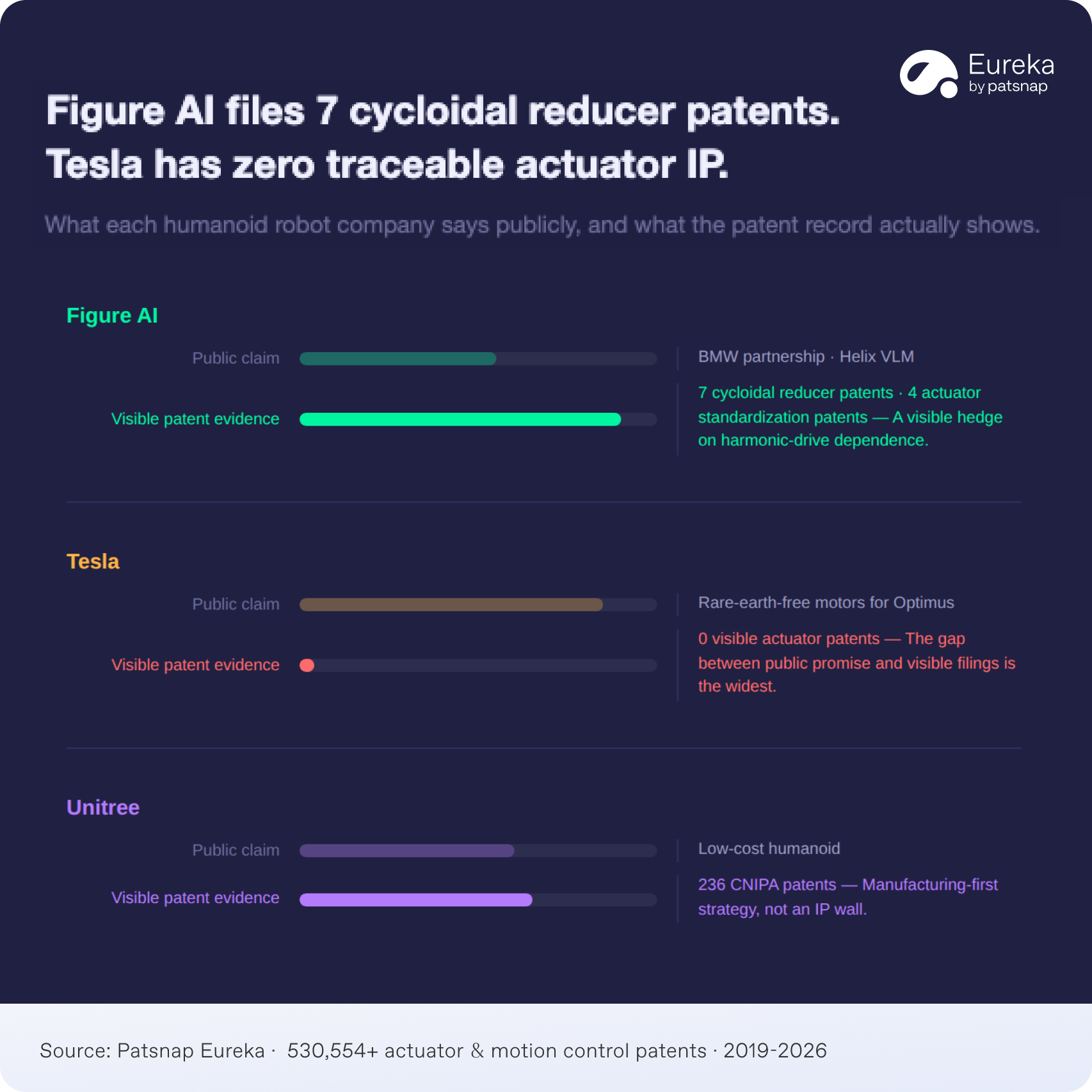
Three companies, three bets — only one is fully legible in the patent record. Figure AI files 7 cycloidal reducer patents at the same pace as Schaeffler and NTN — a harmonic drive hedge that appears nowhere in their press releases. Tesla has no visible actuator patents despite public rare-earth-free motor claims. Unitree’s 236 focused CNIPA patents and $16k G1 are a deliberate manufacturing-over-IP strategy, not a capability gap.
The companies building the alternative supply chain are not robotics companies. Schaeffler and NTN lead cycloidal reducer patents. Gree, LG, and Midea dominate rare-earth-free motor IP. In many of these enabling technologies, humanoid firms look more like future customers or integrators than the original source of IP. Earliest Tier 1 partnership access wins.
1. Why Humanoid Robots Now (and Why the Supply Chain Story Matters)
The most visible story in humanoids is intelligence. The harder constraint is still motion hardware and manufacturing. Foundation models, VLM integration, and general-purpose humanoids by 2027. The implicit assumption: whoever builds the best brain wins.
The factory in Foshan tells a different story.
Since late March 2026, a production line run by Leju Robotics and Dongfang Precision has been assembling one humanoid every 30 minutes — 24 digital assembly stages, 77 quality checks, targeting 10,000 units per year. The constraint on that line is not the model. It is the actuator supply, the gearbox lead time, and the magnet.
UBTECH shipped 1,079 full-size humanoid units in 2025. A 22x increase year-on-year. Humanoids are now its largest revenue segment.
Software progress is real. The binding constraint on scale, for now, is still the supply chain.
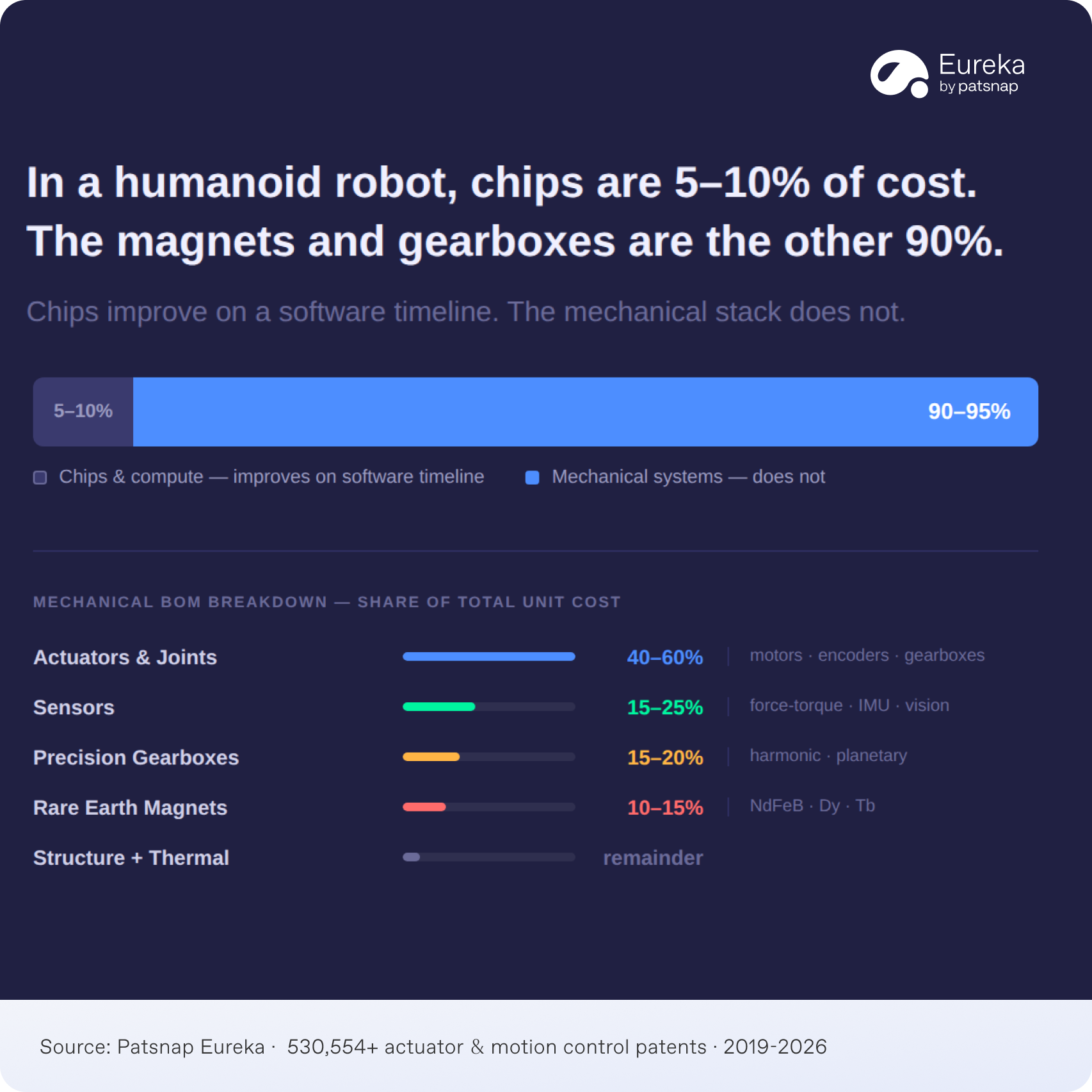
Chips are 5-10% of the total BOM cost. The other 90% is actuators, joints, motors, gearboxes, sensors, and structural systems. None of it improves on a Moore’s Law curve. None of it gets cheaper because a foundation model gets smarter.
On Tesla’s Q1 2025 earnings call, Elon Musk acknowledged that Optimus production was directly limited by China’s rare earth magnet export controls. Not by software. Not by compute. A policy decision about dysprosium and terbium moved faster than any model update.
The patent record makes this concrete. Of 530,554 patents on actuator and motion control, grain boundary diffusion techniques for rare earth reduction account for 64 filings — 0.01% of the corpus. The most active filers are materials suppliers and home appliance manufacturers. Not one humanoid robotics company appears in the top ten.
This is not one node failing. It is an entire supply chain underbuilt relative to the deployment ambitions being announced.
Scope Card
Scope Card Patents examined: 530,554+ (actuator and motion control domain)
Time-series subset:27,515 new filings in 2024; commercial inflection visible in filing structure
Source: PatSnap Eureka
Supplementary data: IDTechEx 2025, Yole Group 2025, Morgan Stanley BluePaper “Humanoids and Global Materials”
Coverage: Tesla, Figure AI, Boston Dynamics, Unitree, UBTECH
Method: Patent family analysis, competitive landscape mapping, supply chain constraint modelling
2. Evidence: What Their Patents Actually Say
Electric won the architecture debate. The supply chain debate for that architecture has just begun. Three findings from the patent record clarify what is actually at stake and who is actually doing something about it.
2.1 The Architecture Is Settled. The Material Stack Is Not.
Start with who is filing rare earth reduction patents: Fujian Changting Golden Dragon Rare-Earth, Ningbo Yunsheng Magnet Technology, Midea Group, Zhejiang University. Materials suppliers, a home appliance manufacturer, a research institution. Not one humanoid robotics company in the top ten.
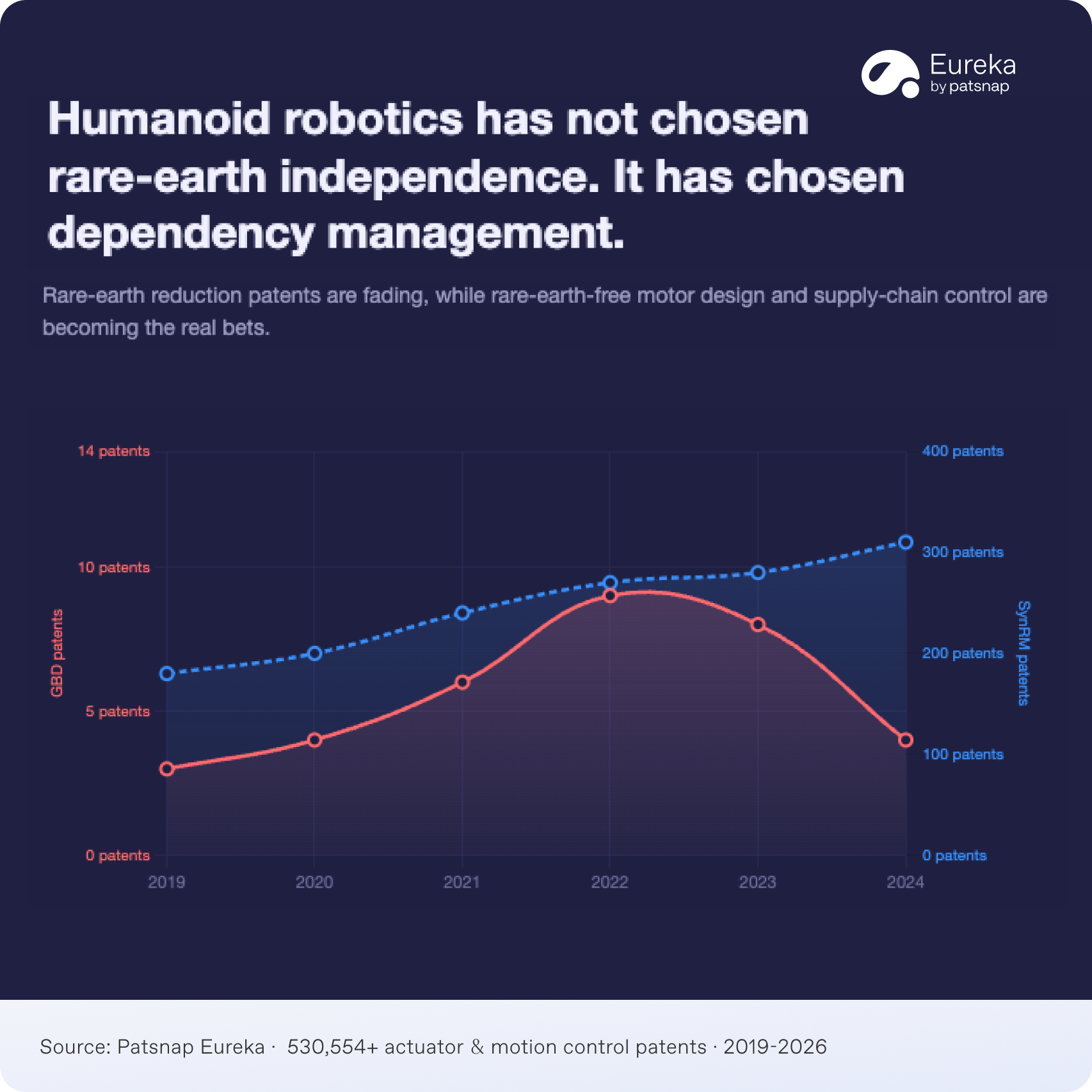
In the full 530,554-patent corpus on actuator and motion control, grain boundary diffusion techniques for rare earth reduction account for 64 patents, 0.01% of the total. Switched reluctance and synchronous reluctance motor alternatives account for roughly 2,500 patents, or 0.5%. The filing trend confirms the trajectory: rare earth reduction patents peaked at 7-9 per year in 2022-2023 and dropped to 4 in 2024. Research intensity is declining, not growing.
This is not a technology gap. Toyota, Nissan, and Mitsubishi Electric have been developing rare earth reduction solutions for automotive applications since the mid-2000s. The engineering exists. What does not exist is anyone transferring that engineering into humanoid robot actuators. Every major platform currently in commercial development is running neodymium-iron-boron permanent magnets. None of them has filed actuator-specific patents on alternatives.
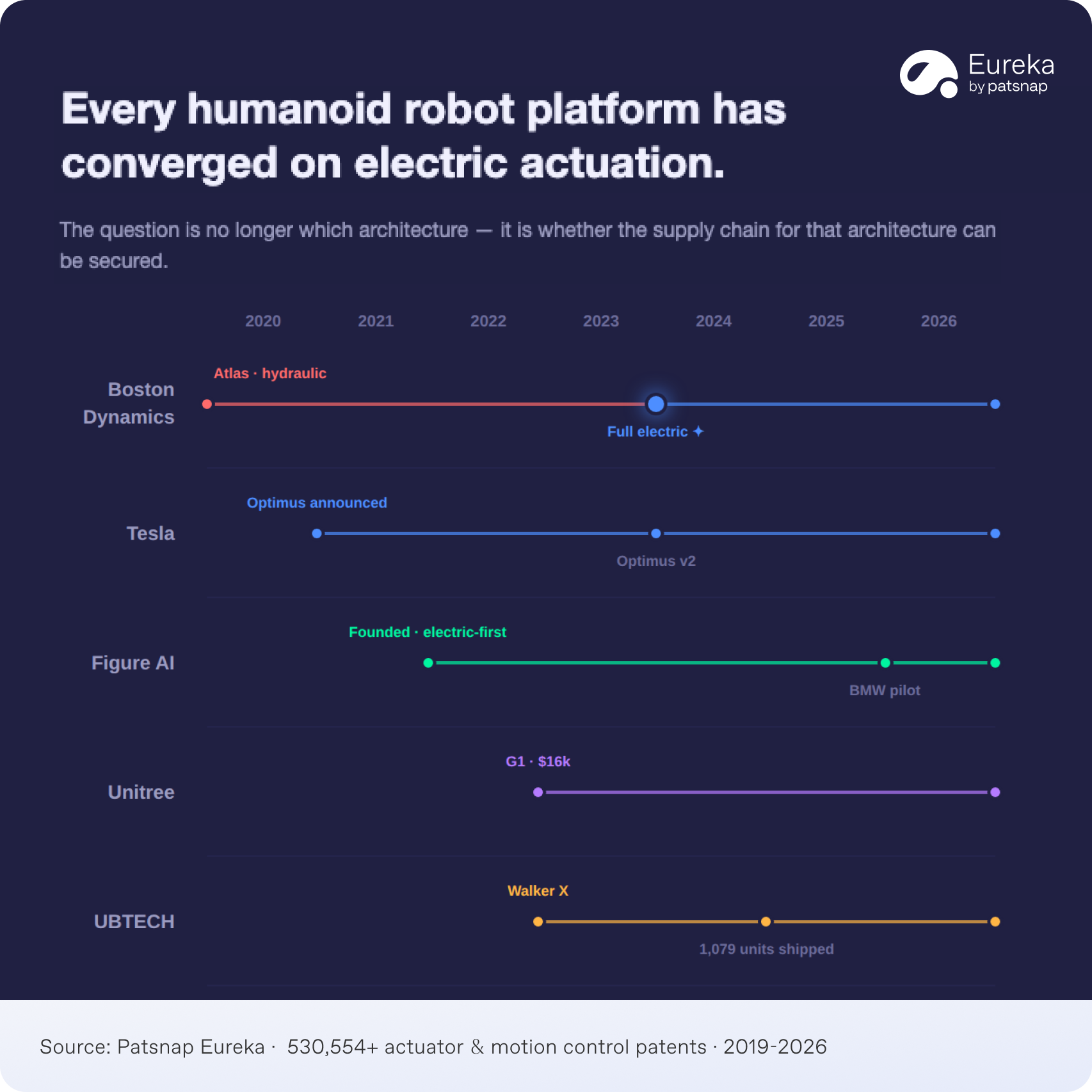
Meanwhile, the architecture question, electric versus hydraulic versus series elastic, is resolved. Boston Dynamics completed its full transition away from hydraulics in 2024. The 2024–2025 filing surge is not merely larger; it is more industrial in composition. Commercial manufacturers and component suppliers account for the bulk of filings, while universities remain concentrated in smaller pockets of force control, whole-body control, and other early-stage control problems. That mix suggests the field is shifting from exploratory research toward scale-up preparation.
The result is a field that has solved the easier problem and deferred the harder one. Architecture: settled. Material stack: unaddressed.
For an engineering team evaluating 2027 factory deployment, rare earth exposure is not a differentiator between platforms. It is a shared condition. Every platform on your evaluation list has the same NdFeB dependency. The November 10, 2026, suspension expiry is the shared risk horizon. The question is whether your deployment timeline has enough buffer if the suspension window closes without renewal.
(Source: PatSnap Eureka)
2.2 Three Companies, Three Bets — Only One Is Fully Legible
The patent record separates the humanoid field into three distinct strategic positions. Understanding which position you are evaluating changes what questions you should be asking.
Figure AI: The architecture bet is visible and coherent.
47 patents filed in 2024-2025, four directly on actuator cost reduction. The strategy across four filings on actuator standardisation (US20260077481A1, WO2025216838A1, US20260077482A1, and US20260070216A1) is consistent: reduce cost by reducing the number of unique parts, not by changing what the parts are made of. US20260077481A1 establishes 42 actuators across 7 torque tiers: Type G at 204-307 Nm for hip and knee loads, down to Type A at 15-22 Nm for wrist and head. Seven base designs instead of 42 unique components means shared tooling, bulk purchasing, and simplified assembly. US20260077482A1 eliminates the independent trunk pitch actuator entirely, using hip flexion geometry to provide the same motion. One fewer joint. One fewer motor. One fewer harmonic drive in the supply chain.
The less visible signal is more important: Figure AI holds 7 patents on cycloidal reducers. In the 2015-2025 cycloidal reducer patent rankings, Figure AI sits alongside HIWIN Technologies, NTN Corporation, and Schaeffler — companies with decades in precision machinery. A startup founded in 2022 is filing cycloidal reducer patents at the same rate as century-old precision engineering firms. This does not appear in their BMW partnership announcements or their Helix model releases. It suggests they are not content to remain dependent on harmonic drive suppliers and are building an alternative path in parallel.
If you are evaluating Figure AI: you are betting on a standardization strategy that reduces unique part count, and a parallel cycloidal reducer development that could reduce harmonic drive dependency. Both bets are legible in the patent record. Both are coherent engineering choices. The BMW pilot in 2026 tests the first bet. The cycloidal reducer patents are a longer-horizon hedge on the second — and the BMW relationship matters as a manufacturing learning environment, not just a deployment reference.
Tesla: The public commitment outran the traceable evidence.
At Tesla’s 2023 Investor Day, the company announced rare-earth-free motors for vehicles and robots. The announcement moved Chinese rare-earth mining stocks. In 82 Tesla patents found in the 2023-2026 window, there is no corresponding R&D evidence for Optimus actuator applications — no clear filings on actuator cost reduction, rare-earth-free motors, or material substitution specifically for robot applications. What does exist is one filing establishing 6 actuator types and underactuated hand designs — real mechanical simplification work, but silent on the material risk that publicly grounded production.
Three explanations are plausible: commercial secrecy, supplier reliance, or automotive motor engineers filing under automotive rather than robotics classifications. Any of these could be true. None of them constitutes a defensible actuator IP moat on the hardest BOM component.
If you are evaluating Tesla Optimus: the production ambition is high-confidence, the traceable technical foundation on material security is not. The Q1 2025 earnings call confirmed the gap between the two when a magnet export license became the binding constraint.
Unitree: The patent structure reveals a deliberate strategic choice.
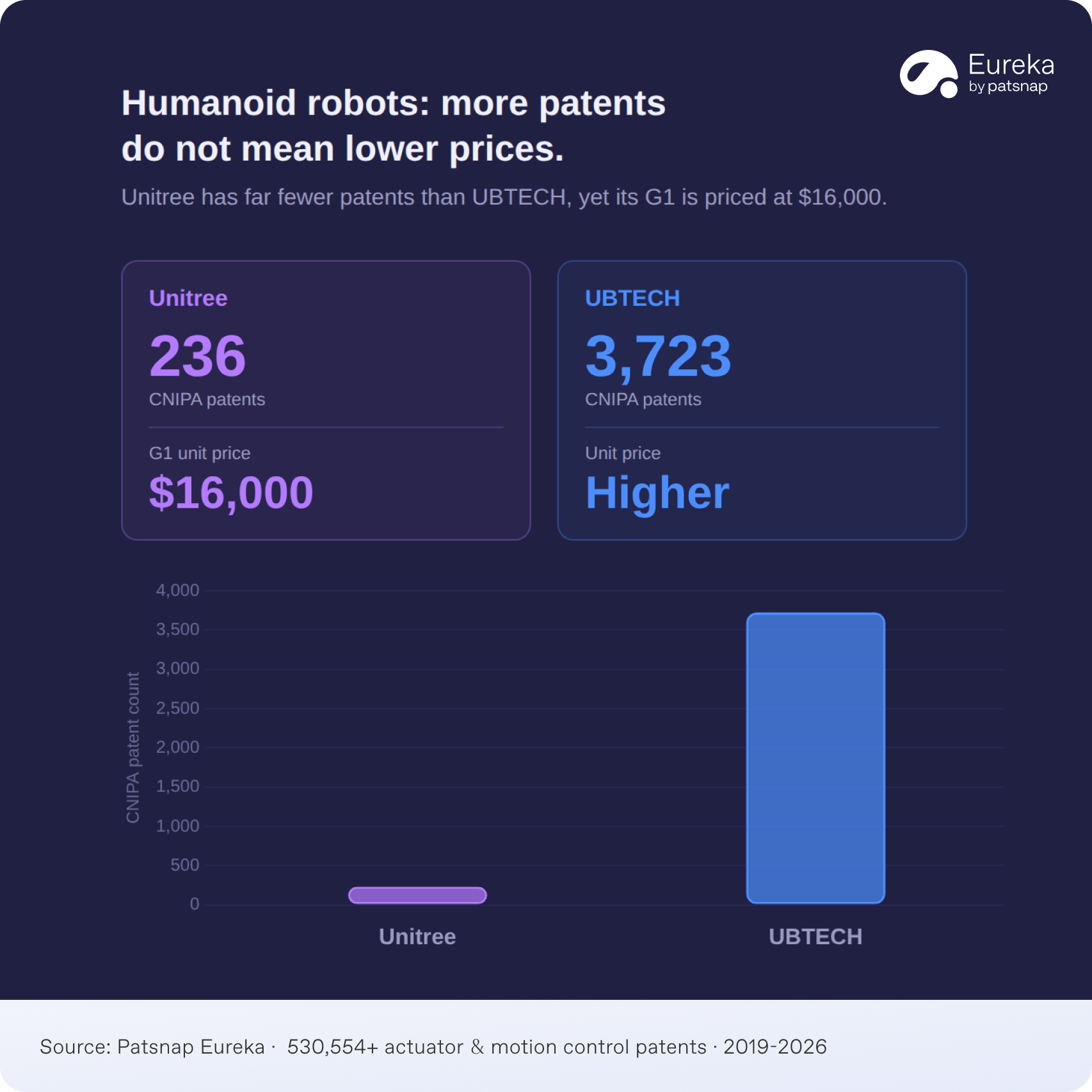
236 patents in CNIPA, concentrated in joint mechanisms and actuation hardware. PCT coverage is limited by design — one filing on torque-sensing harmonic drives is the clearest signal of where their engineering depth actually sits, demonstrating genuine technical capability in precision sensing at the actuator level. The portfolio is intentionally narrow: compete on manufacturing integration and iteration speed rather than building IP walls.
The result is a G1 at $16,000 and an R1 at $5,900. These numbers do not prove that industrial humanoids are cheap or ready for factory deployment. They prove that the cost floor is substantially lower than any Western platform implies. The gap between Unitree’s pricing and Western platform pricing is not explained by quality differences alone — it reflects a fundamentally different theory of competition.
If you are evaluating Unitree: you are not betting on a technology moat. You are betting that manufacturing integration depth and supply chain access in China persist as structural advantages long enough to matter at the deployment scale you care about.
(Source: PatSnap Eureka)
2.3 The Companies Actually Building the Alternative Supply Chain Are Not Robotics Companies
The cycloidal reducer patent rankings answer a question that humanoid robotics coverage does not ask: Who is actually building the precision actuator supply chain that comes after harmonic drives?
Schaeffler Technologies: 7 cycloidal reducer patents. Schaeffler’s core business is automotive bearings and drivetrains. Their entry into cycloidal reducers is not a pivot into robotics; it is precision motion competency extending into an adjacent market where load requirements and tolerance demands are familiar. NTN Corporation holds 8 patents in the same category. HIWIN Technologies holds 8. These are not robotics companies. They are precision manufacturing companies whose existing capabilities map directly onto what humanoid robots will need at scale.
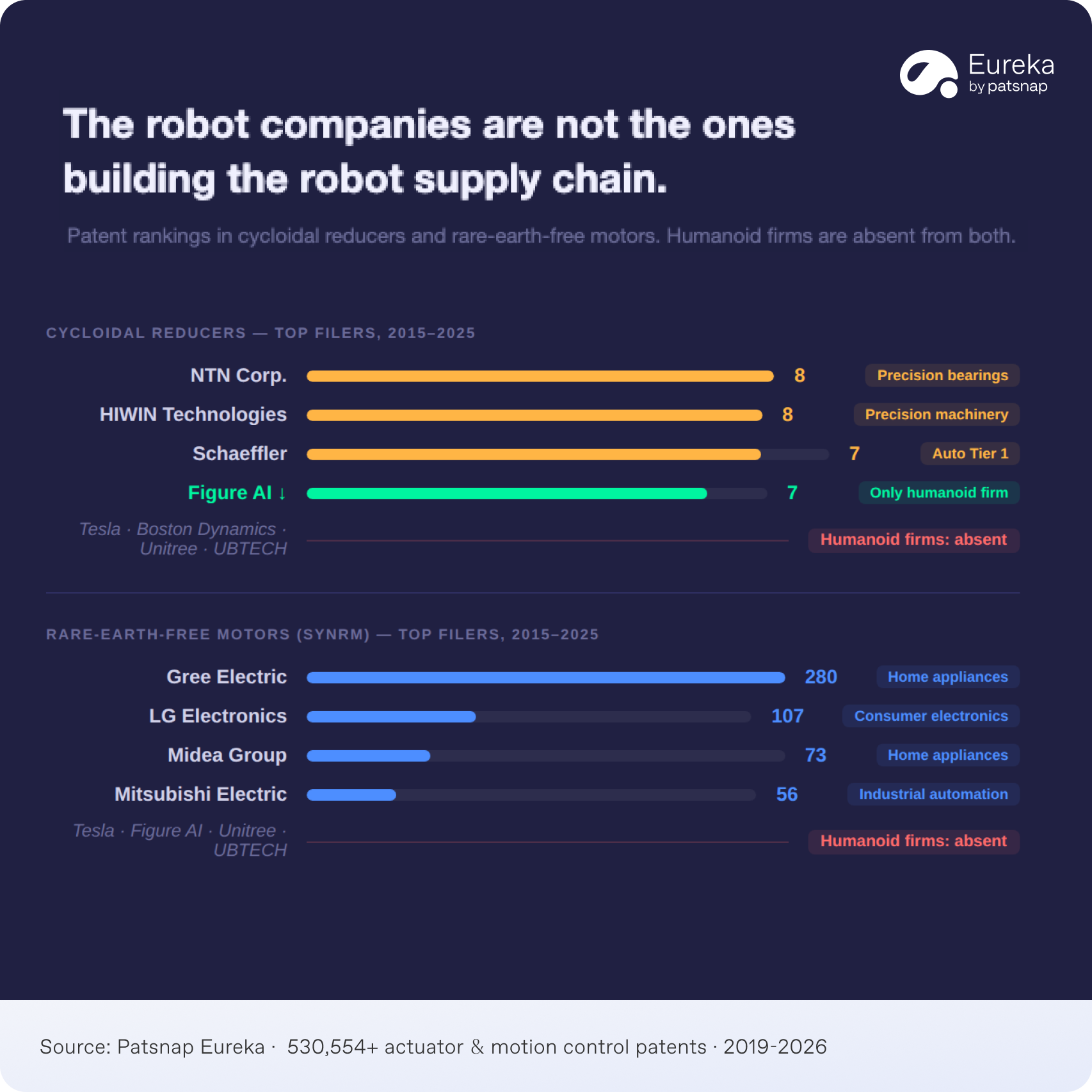
The same pattern holds in motor technology. In synchronous reluctance motors, the most commercially mature rare-earth-free alternative, Gree Electric Appliances leads with 280 patents, LG Electronics follows with 107, and Midea Group holds 73. Three home appliance manufacturers are the dominant IP holders in the technology that could replace NdFeB permanent magnet motors in humanoid actuators. They developed it to reduce compressor costs in air conditioners. The humanoid robotics application is an adjacency, not the original intent.
The structural implication is direct: the supply chain infrastructure for next-generation humanoid actuators is being built by automotive Tier 1 suppliers and home appliance manufacturers as a byproduct of their own electrification and cost pressures. Humanoid robotics companies will be the customers, the acquirers, or the licensees — not the originators. The companies that establish preferred supply relationships earliest have a sourcing advantage that cannot be replicated quickly by competitors, regardless of their R&D spend.
Figure AI’s BMW partnership is not only a deployment pilot. BMW is a Tier 1 automotive ecosystem access point. The same supply chain relationships that make BMW a reference customer also provide proximity to Schaeffler, Bosch, Continental, and the precision motion suppliers now filing cycloidal reducer patents. That adjacency is worth more than the pilot itself.
For an engineering VP evaluating platform selection, the relevant question is not only what each company is filing on. It is the Tier 1 supplier relationships each platform has access to, and how quickly those relationships can convert into preferred supply agreements when the next export control event hits.
(Source: PatSnap Eureka)
3. Five Bottlenecks on the Road to Scale
Media tracks AI capability curves. Engineers track these five numbers. The gap between the two is where deployment timelines actually get decided.
Actuator cost (target: below $500/joint). A humanoid requires 20-30 joints. At current per-joint costs of $500-2,000, actuators alone account for 40-60% of total unit cost. Reaching $20,000-30,000 unit economics requires actuator costs to fall by 60-70%. The signal that this cost reduction is structurally available is already visible: Bosch, Continental, and Nidec are entering the humanoid actuator market. These are automotive Tier 1 suppliers with the manufacturing infrastructure to drive that reduction. The timeline for meaningful volume is 2027-2028. The companies with existing Tier 1 relationships reach that cost curve first.
Rare earth supply security (suspension expires Nov 10, 2026; structural dependency unchanged). The April 2025 export controls made this a production halt, not a risk scenario. The suspension temporarily relieves that constraint. It does not change the material stack. Near-term mitigations exist: grain boundary diffusion reduces dysprosium and terbium consumption by 50-70%, magnet recycling recovers 85-95% of rare earths from end-of-life units, but none are being pursued by the companies that need them most. The November 2026 window is the available time to accelerate diversification before the next policy decision resets the clock.
Precision gearbox supply gap (80,000-unit shortfall by 2028). At the projected 2028 demand of 100,000 humanoid units annually, the reduction gear shortfall alone exceeds 80,000 units — a doubling of current global capacity. Japan holds 60% of precision harmonic drive production. China holds 19%. Capacity expansion lead times run 24-36 months, structurally mismatched against the demand curve. Chinese manufacturers are closing the cost gap, localisation rates rising from 40% to 60% in 2026, at 30% below import prices. But precision and durability for high-duty industrial applications remain below Japanese benchmark levels. The cycloidal reducer patent activity from Schaeffler, NTN, and Figure AI is an early signal that the alternative supply chain is being built. It is not yet built.
Whole-body control generalisation (retraining: weeks today, target: hours). Factory deployment requires adapting to new tasks, new part geometries, and new assembly sequences without extensive retraining cycles. This is the one bottleneck where the AI story is genuinely relevant. Foundation models for robotics are reducing adaptation timelines — Figure AI’s Helix VLM and Tesla’s end-to-end neural network approach both represent real progress. But the commercial threshold has not been demonstrated in sustained factory operation: 95% uptime with genuine task variation, not scripted sequences. Current early deployments run at 70-85% uptime. The BMW and Hyundai pilots in 2026 are the first real stress tests. What matters in those pilots is not the announcement — it is whether the uptime number and the task variation data get published.
Manufacturing assembly complexity (40-60 hours/unit, not yet automatable). Humanoid assembly requires precision alignment, cable routing through articulated joints, and extensive calibration — none of which is easily automated with current tooling. IDTechEx described this as “insufficient output from precision planetary roller screws manufacturers” — not a metaphor for general manufacturing difficulty, but a literal description of sub-assembly bottlenecks. Establishing the supplier qualification processes, standardized component specifications, and quality systems required for mass production typically requires 3-5 years of development. Companies that started that process in 2022-2023 are structurally better positioned for 2027 scale-up than those treating manufacturing readiness as a downstream problem. Vertically integrated players — Tesla, UBTECH — have a structural edge here. Partnership-model players — Figure AI — face more exposure on this dimension specifically, which makes the BMW relationship more important as a manufacturing learning environment, not just a deployment reference.
(Source: PatSnap Eureka)
4. Solutions: A Practical Route-Selection Framework for Engineering Teams
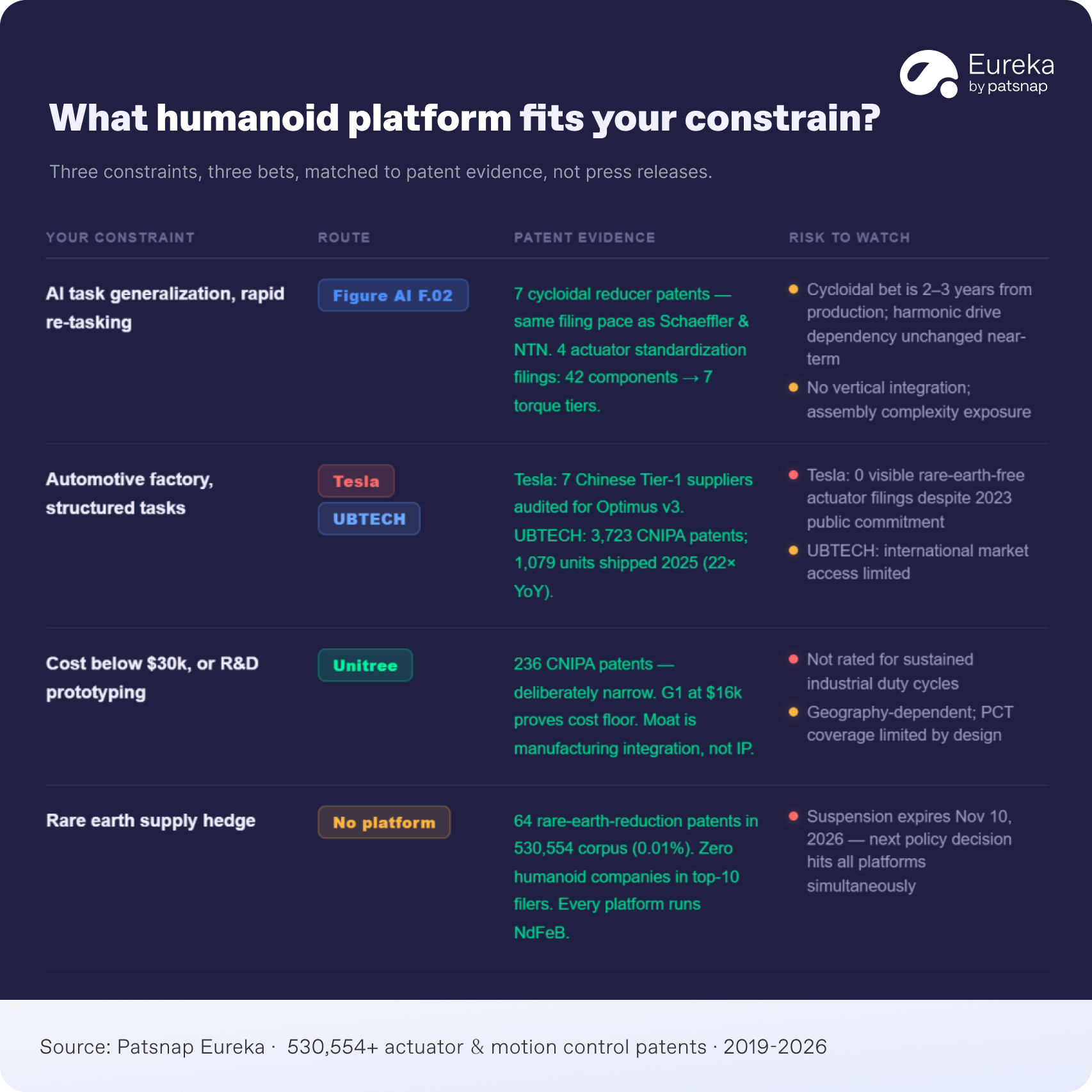
Three questions cut through most platform evaluation decisions:
Does the patent record show coherent, multi-year bets on actuator cost and supply chain hedging, or primarily announcements? Figure AI’s cycloidal reducer patents and standardisation filings are coherent and multi-year. Tesla’s actuator patent record does not match its public commitments. Unitree’s patent structure is deliberately narrow — that is a strategy, not a gap.
Is the moat in IP, manufacturing integration, or supplier access? These are different bets with different durability. IP moats (UBTECH’s 3,723 patents) provide global market protection but require maintenance and litigation infrastructure. Manufacturing moats (Unitree) are faster to build but geography-dependent. Supplier access moats (Figure AI via BMW ecosystem) are the hardest to replicate but the slowest to materialise.
When the next export control event hits — and the November 2026 suspension expiry is the nearest horizon — which platform has the shortest recovery path? Today, the answer is none of them. The differentiator is the deployment timeline buffer and Tier 1 relationship depth, not platform-specific technology.
This chart maps constraints to evidence. It is not a purchase recommendation. Platform capabilities are evolving; verify current specifications against your specific deployment requirements before making procurement decisions.
For teams needing to run your own patent scope analysis across actuator architectures, supply chain dependencies, or competitor IP portfolios: PatSnap Eureka.
5. Signals to Watch in the Next 3-5 Years
Patent evidence is a snapshot of where R&D investment was placed 18-24 months ago. These five signals are the forward indicators that will tell you whether the supply chain story resolves in 2027-2028 or defers again.
Signal 1: Automotive pilot uptime data (MONITORING, watch: Q3-Q4 2026)
The BMW-Figure AI and Hyundai-Boston Dynamics factory pilots are the first sustained real-world stress tests of commercial humanoid deployment. What matters is not the announcement; both have already been announced. What matters is whether operational data gets published: uptime percentage over a sustained period, task success rate, and critically, whether the robots are handling genuine task variation or running scripted sequences in controlled conditions.
The threshold that makes the 2027 scale-up timeline credible is 90%+ uptime over six months with documented task variation. Below that threshold, the honest assessment is that the commercial threshold (95% uptime with rapid adaptation) has not been demonstrated, and factory deployment timelines move out by 2-3 years. Watch for operational data releases in Q3-Q4 2026. Absence of data is itself a signal.
Signal 2: Rare earth suspension expiry — November 10, 2026 (CONFIRMED trigger, watch: renewal decision)
The April 2026 suspension following Kuala Lumpur trade consultations created a defined decision window. The suspension expires November 10, 2026. Whether China renews, extends, or reimplements controls at that point is determined by the state of U.S.-China trade relations, not by engineering timelines. This is the signal with the shortest horizon and the highest industry-wide impact.
Watch for two parallel developments before the expiry: first commercial-scale NdFeB magnet output from MP Materials’ U.S. facilities, and qualification of grain boundary diffusion processes at volume by any humanoid platform’s supply chain. If neither has happened before November 10 and controls are reimposed, production timelines compress across the entire industry simultaneously, not differentially. Every platform faces the same exposure.
Signal 3: First sub-$500 integrated actuator module from Tier 1 supplier (MONITORING, watch: 2027-2028)
Bosch, Continental, and Nidec entering the humanoid actuator market have the manufacturing infrastructure to drive the 60-70% cost reduction required for $20,000-30,000 unit economics. The specific signal to watch is the first commercially available integrated motor-gearbox-encoder module priced below $500 from a supplier with automotive-scale production capacity.
That announcement will compress the cost curve faster than any single company’s vertical integration strategy. It will also shift negotiating power in the supply chain — platforms with existing Tier 1 relationships get preferred pricing and allocation. Platforms without those relationships face spot market exposure. Figure AI’s BMW ecosystem access becomes most valuable at exactly this moment.
Signal 4: First cycloidal reducer supply agreement between a Tier 1 precision supplier and a humanoid platform (MONITORING, watch: 2026-2027)
This is the signal that converts the patent activity identified in Section 2 into operational supply chain reality. Schaeffler, NTN, and HIWIN are all filing cycloidal reducer patents at the same rate as Figure AI. When one of them announces a commercial supply agreement with a humanoid robotics platform — not a research partnership, a supply agreement — the alternative to harmonic drives becomes real rather than potential.
Figure AI is the most likely counterparty given their 7 cycloidal reducer patents and BMW ecosystem access. But the signal matters regardless of which platform it involves: it marks the moment the harmonic drive supply chain constraint begins to have a credible alternative.
Signal 5: Software consolidation across hardware platforms (MONITORING, watch: continuously)
NVIDIA GR00T deployment on Foxconn’s Blackwell production lines and Skild AI’s robot brain integration signal the beginning of a platform consolidation dynamic. A unified foundation model running across multiple hardware platforms reduces software as a differentiator and shifts competition back to hardware cost, supply chain depth, and manufacturing reliability, exactly the dimensions this article has argued matter most.
Watch for the first factory where multiple humanoid brands operate on a shared software stack. That announcement marks the end of the software-moat phase and the beginning of the phase where the five bottlenecks in Section 3 become the primary competitive variables.
(Source: PatSnap Eureka)
Conclusion
The brain problem is being solved faster than the body problem. That asymmetry is the central fact of humanoid robotics in 2026, and still underweighted in the most visible coverage of the field.
Foundation models are improving on a software timeline. Actuator costs, rare earth dependencies, gearbox supply gaps, and assembly complexity are improving on a manufacturing and materials timeline. Those two timelines do not move at the same speed, and no amount of model capability closes the gap between them.
The companies doing something different are already visible in the patent record: Figure AI filing cycloidal reducer patents at Tier 1 supplier pace, Unitree building a manufacturing moat instead of an IP wall, Schaeffler and Gree developing the alternative supply chain as a byproduct of their own cost pressures, long before they are visible in the press.
The demo cycle and the deployment cycle are running on different timelines. The patent record already knows which one is further ahead.
Evidence & Engineering is a field journal on evidence-driven engineering decisions. We dissect technical routes, validate industry narratives, and turn signals into deliverables. Published by the team behind PatSnap Eureka.
 | A guest post by
|